


Your Wedding Smile Leicester: A Dentist's Timeline for the Big Day

Most couples I meet give themselves somewhere between six and twelve months to get fit before the wedding. Nobody expects to walk into the gym three days before and come out with a different body. Your smile works the same way. Some of it can be done in a fortnight, some of it needs the best part of a year, and the order you do things in matters as much as what you choose.
Think of the wedding photos as the finish line. The fitness plan is about strength first and definition second: build the foundation, then shape it. In dentistry the foundation is healthy gums and teeth, the shaping is straightening, and the finishing touches are whitening and bonding. Skip the foundation and everything layered on top is less predictable.
This guide walks through each option with honest pros and cons, how far ahead you need to start, and how to find a dentist you trust with something you will be smiling with long after the confetti is swept up. We welcome you to visit Smile Serenity Dental Care in Leicester.
Ashwyn Roy, Principal Dentist, Smile Serenity Dental Care, Aylestone, Leicester - 05/11/2026

The order matters as much as the timing: straightening moves the teeth, whitening sets the colour, and bonding is matched to both at the end.
Start with dental health: the warm-up nobody skips - Your Wedding Smile Leicester
When: 12 months or more before the wedding, or as soon as you are engaged.
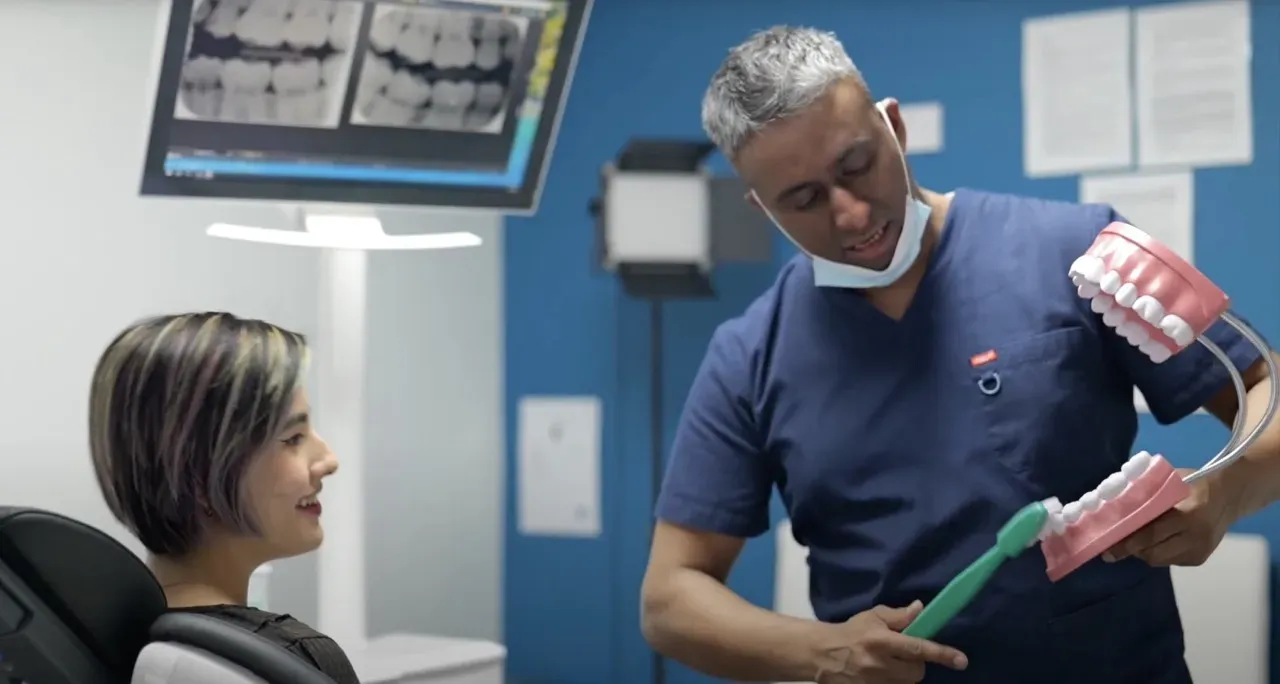
Before anyone talks about whiter or straighter teeth, I want to know the teeth and gums are healthy. A full examination with X-rays shows up decay hiding between teeth, old fillings that are failing, and gum inflammation that bleeds when you brush. None of that photographs well, and all of it affects what we can safely do next.
It is a bit like a physio checking your knees before you start a running plan. You could skip it, but if something gives way halfway through training, the whole schedule slips.
A hygiene appointment fits in here too. Removing tartar and surface staining often brightens a smile more than people expect, and it gives whitening a clean surface to work on.
Advantages
Picks up problems early, while there is still time to treat them calmly rather than in a rush
Healthy gums are pink and firm rather than red and puffy, which makes a real difference in close-up photos
Every cosmetic option that follows is more predictable on a healthy mouth
Disadvantages
It can uncover treatment you were not planning for, such as a filling or gum care
If treatment is needed, it adds appointments to an already busy year
That second point is exactly why it comes first. Finding a problem a year out is an inconvenience. Finding it three weeks before the wedding is a stress you do not need.
If you are not already registered with us, a dental examination is the starting point. Our dental plan also covers check-ups and hygiene visits through the year, which suits couples who want to keep things ticking over in the run-up.
Teeth straightening: the long training block
When: 9 to 18 months before the wedding.
Straightening is the marathon training of wedding dentistry. It takes the longest, it needs steady commitment, and it is the one you cannot cram. With clear aligners such as Invisalign, simple cases often take 3 to 6 months, while more involved crowding or bite correction can run 6 to 12 months or longer. On top of that, most cases need a round of refinement aligners at the end, because it is rare for every tooth to land perfectly first time.
So why start so early? Because the timeline needs slack. Aligners only work when they are worn, roughly 22 hours a day, and a few weeks of lapses add up. Building in a buffer means the last aligner comes off with time to spare, not the week of the wedding.
There is a second reason that people rarely hear about. If you are thinking about bonding or veneers as well, straighten first. Bonding over crowded teeth that still want to move makes later correction harder, and it usually means adding more material to disguise the crowding. Moving the teeth into a better position first often means less bonding is needed, or none at all.
Advantages
Corrects the position of the teeth rather than disguising it
Straighter teeth are easier to clean, which helps long-term gum health
Clear aligners are discreet, so engagement photos and work meetings are unaffected
Often reduces how much cosmetic work is needed afterwards
Disadvantages
The longest timeline of any option here, and it does not speed up if you leave it late
Results depend on you wearing the aligners as prescribed
Retainers are for life: full time for the first months, then at night, to stop teeth drifting back
A bigger investment than whitening or a few bonded edges
If the wedding is less than about nine months away, it is still worth a free Invisalign consultation. For minor crowding, a shorter system may fit. If it does not, I would rather tell you honestly and plan straightening for after the honeymoon than promise something the calendar cannot deliver.
Teeth whitening: the final few weeks of toning
When: start 3 to 4 months before, finish at least 4 weeks before the day.
Whitening is the toning phase. It does not change shape or position, it lifts the colour of what is already there. Dentist-supervised home whitening uses custom trays and a whitening gel, usually worn for a few weeks. Most people see a visible change within the first week or two.
Timing is where couples tend to get caught out. Straight after whitening, teeth are slightly dehydrated and can look a touch brighter than where they will settle, and some people feel sensitivity for a few days. Finishing a few weeks early lets the colour settle so you know what you are working with, and leaves time for a top-up if you want one.
The other thing I always explain: whitening only works on natural enamel. Fillings, crowns and composite bonding stay the colour they were made. So if you are planning bonding, whiten first and match the bonding to your new shade afterwards. Do it the other way round and the bonding will look darker than the teeth around it.
Advantages
Non-invasive: nothing is drilled or removed
One of the quickest visible improvements you can make
Custom trays can be kept for top-ups before anniversaries and future events
Disadvantages
Temporary sensitivity is common in the first few days
Does not change fillings, crowns or bonding
Colour fades gradually with tea, coffee and red wine, so occasional top-ups are needed
Results vary from person to person, and some deeper staining responds less well
In the UK, whitening gel at an effective strength can only legally be provided by a dentist, after an examination. That rule exists for good reason, so be wary of salon or online kits. A whitening consultation is the place to find out what is realistic for your teeth.
Composite bonding: choosing your stylist
When: 1 to 3 months before, and at least 2 weeks after whitening has finished.
Composite bonding is tooth-coloured resin, sculpted by hand onto the tooth to close small gaps, even out chipped or worn edges, or soften the shape of a tooth. It is usually done in one or two visits, often with little or no drilling.
I describe bonding as an art, because it is. The material is the same in every practice. What differs is the eye and hand of the person shaping it. Finding the right dentist for bonding is a lot like finding the right hairstylist. You look at their previous work, you check they understand the look you are after, and you want someone who will tell you when an idea will not suit you.
There is one big difference, though. A haircut you are unhappy with grows out in a few weeks. Bonding does not grow out. It is a long-term change, and it is not fully reversible.
Think of it like a poster stuck on a painted wall. It looks great while it is up, and you can take it down. But peel it off and sometimes a little paint comes away with it. Bonding is similar. To bond well, the surface of the enamel is prepared so the resin grips, and when bonding is later removed or replaced, a small amount of enamel can be lost along the way. Enamel does not grow back. That is why I treat bonding as a considered decision, not an impulse before a big event.
Advantages
Quick, often finished in a single visit
Usually very conservative compared with crowns or veneers, with little or no tooth removed
Can be adjusted, polished or repaired if a small chip happens
Shade-matched to your teeth, ideally after whitening
Disadvantages
Not fully reversible: removal can take a little enamel with it
Composite can stain and lose its polish over time, so it needs maintenance
Edges can chip, particularly if you grind your teeth or bite nails or pens
Will not whiten later, so the shade you choose now is the shade it stays
The result depends heavily on the skill of the dentist doing it
Doing bonding a month or two before the wedding, rather than the week before, gives time for a review appointment. Small tweaks to shape or polish are easy then, and much less stressful than trying to fix something two days out.
Finding the right dental practice
You would not book a wedding photographer without looking at their portfolio, and the same applies here. A few things worth checking:
Their own work. Ask to see before-and-after photos of cases the dentist did personally, especially bonding.
Health first. A good practice will want to examine your teeth and gums before discussing cosmetics. If someone offers bonding without looking at your gums, that tells you something.
A plan, not a menu. The right dentist explains what order things should happen in, and why, rather than selling single treatments.
Honesty about time. If your date is too close for something, you should hear that plainly, with an alternative.
Registration. Check the dentist is registered with the General Dental Council and the practice with the Care Quality Commission.
Aftercare. Ask what happens if a bonded edge chips or a tooth drifts after aligners. Retainers, reviews and repairs should be part of the conversation from the start.
Clear costs. You should know the price of each stage up front, and whether finance is available. At Smile Serenity we offer 0% finance over 12 months, subject to status.
Above all, choose someone you feel comfortable asking questions. You may well be seeing them several times over the year, and a relaxed relationship makes the whole process easier. You can meet our team before you book.
Balance is key
The best wedding fitness plans are not about looking like a different person. They are about looking like the best version of yourself, and still feeling like you when you see the photos years later. Smiles are the same.
There is no rule that says you need every treatment. For some couples a check-up, a hygiene visit and a few weeks of whitening is plenty. Others want straightening because a crooked tooth has bothered them for years, and the wedding is simply the push to finally do it. Bonding can be lovely, but because it is long term and not fully reversible, it deserves the same thought you would give any permanent change.
My advice is to start early, put health before cosmetics, and choose a dentist who will tell you when less is more. A natural, healthy smile that looks like yours will always photograph better than one that tries too hard.
For that wedding smile, come visit us in Leicester. If you have a date in the diary, book a free smile consultation at Smile Serenity in Aylestone, Leicester. Bring your date and we will work backwards from it together.
Individual results vary. All treatment follows an examination and a discussion of the options, risks and costs.
Published on 05/11/2026 by Dr Ashwyn Roy - Principal Dentist at Smile Serenity Dental Care in Leicester - GDC 272634

Planning a wedding smile takes time, and this article offers a useful reminder to consider dental treatments well before the celebration. I appreciate the focus on preparation, realistic timelines, and achieving natural-looking results. Exploring resources like calgary dentist can also help readers understand available cosmetic options. Thoughtful planning makes the journey toward a confident wedding smile easier.
I like this Blog